Overview
How the persona set was derived, what every persona shares, the journey they follow, and how plans and channels segment them.
Polylane is proactive agents for production: agents that read your code, watch your infrastructure, detect issues, investigate them, and fix them. The brand promise is "Nobody should be on-call in 2026." The go-to-market is bottom-up and self-serve: developer tools are consumer tools, win developers one at a time, no enterprise motion at this stage.
These personas were derived from a deep analysis of the product itself: its positioning and messaging, pricing and plan structure, onboarding funnel, lifecycle emails, console features, and the depth of each integration. They are inferences, not interview data. Treat them as a strong starting hypothesis to validate against real signup answers, founder check-in replies, and churn feedback.
The ICP
One ICP sits above the personas: AI-pilled software teams at any scale. The qualifier is temperament, not stage or headcount: the team ships with AI-first tools and is comfortable letting an agent do real work. The personas below describe who inside those teams; the ICP page describes which teams qualify and why.
The personas
| # | Persona | Archetype | Typical plan | One line |
|---|---|---|---|---|
| 1 | Pete, the indie hacker | Indie hacker / solo founder | Free → Starter ($80) | Solo builder on Cloudflare or Vercel who is their own on-call and finds out about outages from customers |
| 2 | Max, the product engineer | Software engineer | Max ($200) or a seat on Team | Full-stack engineer at a small startup, ships daily with a coding agent, dreads the pager |
| 3 | Laura, the founding CTO | Exec (CTO / VP Engineering) | Team ($200) | Player-coach CTO of a 10-40 person startup buying leverage instead of an SRE hire |
| 4 | Marcus, the platform engineer | SRE / DevOps / platform | Team → Enterprise | Pragmatic platform engineer at an AWS/Kubernetes scale-up, evaluates cautiously, secondary persona today |
Priority order matters. Pete and Max are the bullseye and match the beachhead strategy: developers on fast-growing cloud platforms (Cloudflare, Vercel, Supabase, Railway, Fly.io) who ship faster than anyone and have almost no native operations tooling. Laura converts individual adoption into a team account. Marcus is the expansion persona: several tools he considers table stakes (PagerDuty, Grafana, GitLab, Terraform-aware linking) are not live yet.
What all personas share
- They are developers or ex-developers. The product's docs and console assume fluency with cloud providers, metrics, logs, traces, Git and PR workflows, and MCP. Nothing is written for a non-technical buyer.
- They already use an AI coding agent daily (Claude Code, Cursor, Codex, or similar). The fastest onboarding path is handing that agent one setup prompt.
- They ship on modern platforms through GitHub. GitHub is the only live code host; the deepest cloud integrations are Cloudflare, AWS, Vercel, Render, Fly.io, Kubernetes, and PlanetScale, with Datadog, Honeycomb, Axiom, Sentry, and Slack alongside.
- They are allergic to noise. Every persona has been burned by alert spam. The product's stance that silence is a feature, and that the default verdict is "no anomaly", is a prerequisite for trust with all four.
- They carry on-call pain in some form, from "my phone is the pager" (Pete) to "I own the rotation's quality" (Marcus).
- They respond to the same product taste: dense, fast, restrained, opinionated, closer to Linear than to a dashboard vendor.
The shared journey skeleton
Every persona walks the same ladder; they differ only in how fast, how alone, and how skeptically.
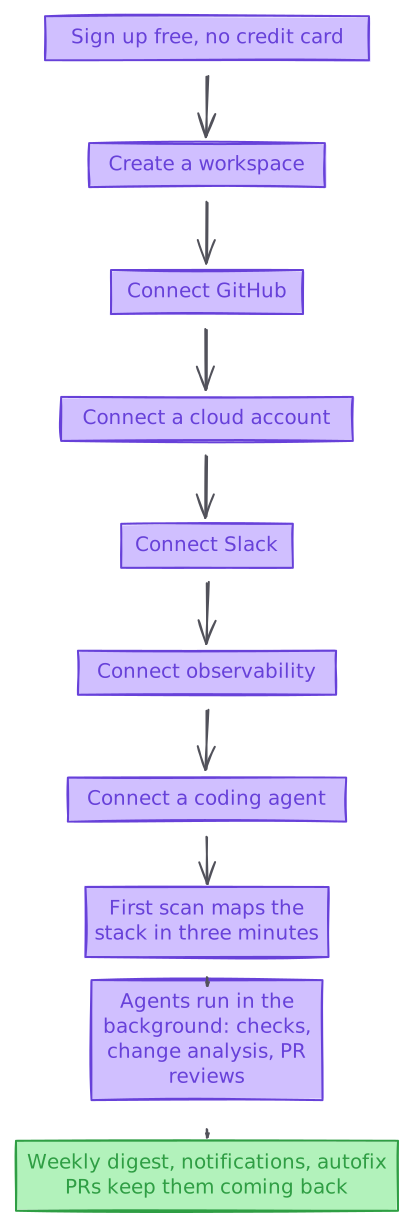
The details that vary by persona: a work email produces a company-named workspace with optional domain auto-join, a personal email a solo one; disposable domains are rejected outright; reminder emails nudge each unconnected rung over the first two weeks, personalized by what the product finds in already-connected repos; and founder check-in emails arrive at signup and on churn signals.
How plans segment the personas
Plans are grouped into Individual (Starter, Max) and Team (Team, Enterprise). The unit of value is credits: cost-weighted AI tokens, where heavier models burn more credits per response. Overage is metered in small increments with a default monthly spending cap. Upgrade pressure comes from the credit pool, the automatic-incident cap, and cloud-account limits.
| Plan | Price | Seats | Built for |
|---|---|---|---|
| Free | $0 | 1 | Pete trying it out: 2 clouds, 1 automatic incident per day |
| Starter | $80/mo | 1 | Pete in production: 10 clouds, unlimited incidents, pay-as-you-go overage |
| Max | $200/mo | 1 | Max as a power user: unlimited clouds, 4x Starter credits, priority routing on frontier models |
| Team | $200/mo | up to 50 | Laura's team: shared credits, shared memories and skills |
| Enterprise | custom | unlimited | Marcus's org later: volume credit pricing, bring-your-own LLM key and AI gateway, bring-your-own cloud, dedicated support |
Where to reach whom (summary)
| Persona | Best channels | Worst channels |
|---|---|---|
| Pete | Cloudflare/Vercel marketplaces, X build-in-public circles, Hacker News, Product Hunt, dev YouTube, the shareable topology map itself | Cold email, LinkedIn ads, gated content |
| Max | The PR comment surface itself, coding-agent communities, framework Discords, GitHub, word of mouth in team Slack, dev newsletters | Webinars, anything requiring a sales call |
| Laura | Their own engineers (bottom-up), founder and CTO communities, The Pragmatic Engineer-style newsletters, warm intros, the forwarded weekly digest | Cold outbound, feature-checklist comparisons |
| Marcus | Deep technical blog posts, SRE/DevOps newsletters and podcasts, KubeCon/SREcon/Monitorama hallways, r/devops and r/sre, transparent security documentation | AI-magic marketing, anything hiding the IAM policy |
Anti-personas
- Procurement-led enterprise buyers. No sales team, no SSO/RBAC depth, no compliance paperwork motion yet, by explicit choice.
- Dashboard power users who want another observability dashboard to stare at and hand-write queries in. The agent does the querying; the product positions against observability without action.
- Legacy VM and datacenter shops. The integration surface assumes serverless and PaaS with config-file-driven deploys.
- Non-GitHub teams, for now.
- Anyone who wants a fully hands-off replacement for engineering judgment. Every persona still reviews and merges the fix.